Fee & pricing model review
Document-style review of your pricing page, fee disclosures, invoice structure, and plan naming to reduce confusion and support tickets.
Pricing page
Invoice example
Footnotes
Transparent scope • Practical templates • Customer-ready wording
SaaS Fees is a small, local, documentation-first consultancy focused on helping SaaS teams explain pricing, fees, billing events, and policies in plain English. We emphasize transparent scope, realistic expectations, and operational details customers can actually use.
“Billing clarity is operational work. Good docs don’t just describe a policy—they describe the moment the customer experiences it.” — SaaS Fees working principle
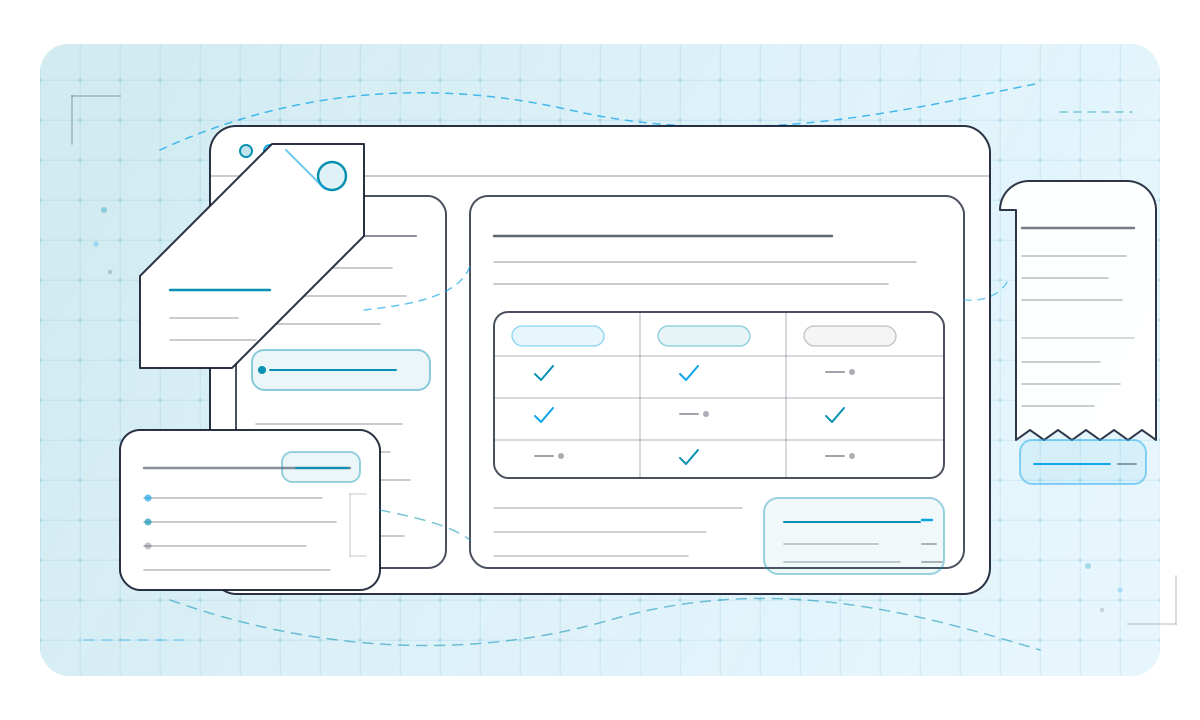
Doc-style overview + operational details you can reuse.
We use a factor-based matrix so customers can compare options without competitor claims. This is designed for pricing pages, sales docs, and onboarding emails.
| Factor | Definition | Customer question it answers | Evidence to link |
|---|---|---|---|
| Billing trigger | What event creates a charge (signup, renewal date, usage threshold). | “When will I be charged and why?” | Policy excerpt + invoice example |
| Proration rules | How upgrades/downgrades apply mid-cycle (credit, charge, next invoice). | “If I change plans mid-month, what happens?” | Plan-change page + FAQ |
| Taxes & exemptions | How tax is calculated and what documents are needed for exemptions. | “Why is tax on my invoice?” | Tax policy + required fields list |
| Refund boundaries | What is refundable, time limits, and non-refundable items. | “Can I get a refund if I forgot to cancel?” | Refund policy + cancellation path |
| Fee disclosure | Where fees can appear (payment method, invoice surcharge, add-ons). | “Are there extra fees beyond the plan price?” | Pricing page footnotes + invoice terms |
We don’t publish statements like “Vendor X is cheaper” or “Vendor Y has bad refunds.” Instead we provide a neutral matrix template your team can populate with verifiable, up-to-date information.
If you need help selecting factors, start with billing events (trial → paid, renewal, upgrade, cancellation) and customer-support drivers (tax invoices, refund exceptions, chargebacks).
This approach helps reduce disputes because customers see the rule before the bill arrives.
Each service links back to the Services hub so your internal docs remain navigable and consistent.
Document-style review of your pricing page, fee disclosures, invoice structure, and plan naming to reduce confusion and support tickets.
A readiness checklist for trials, renewals, proration, taxes, and refunds, with included/not-included boundaries and customer-facing wording.
A neutral feature-and-fee matrix template to help customers compare options using consistent factors and clear definitions.
We write documentation like an ops manual: clear boundaries, explicit triggers, and a path to resolution. Below is a teaser of the prep checklist we use before a review.
Bring these items and we can review quickly and realistically:
These boundaries reduce disputes by matching the promise to the operational reality.
| Area | Included | Not included |
|---|---|---|
| Pricing copy | Rewrite fee disclosures, plan naming, and footnotes for clarity. | Repositioning, demand gen messaging, or SEO growth claims. |
| Billing events | Document trial → paid, renewals, plan changes, and cancellations. | Implementing changes in your payment processor. |
| Refund path | Draft customer-facing rules and internal approval steps. | Legal determinations or tax treatment decisions. |
A pricing page says “Cancel anytime” while the billing system renews at midnight UTC with no reminder and refunds are only granted under exceptions. We align the wording with the real sequence: reminder window, cancellation cutoff, and how to request an exception.
Result: fewer “I didn’t know” tickets, less back-and-forth, and clearer internal handling.
Selected feedback from local Bay Area teams we’ve supported.
“Clear, practical guidance on how to present fees and renewals without overpromising. The checklists were immediately usable.”
“The included/not-included table helped us tighten scope and reduce billing disputes. Straightforward and realistic.”
“Helpful matrices and policies language that reads like a real ops manual. Customers asked fewer repeat questions.”
We keep this straightforward: clear channels, realistic response times, and a written record when needed. If you have a complaint about a deliverable, we follow the steps below.
Note: We can revise documentation and clarify wording. We don’t provide legal determinations or payment processor interventions.
Prefer a dedicated page? Visit Contact. For scope and deliverables, use the Services hub.
This form opens your email client (mailto). We validate the fields before composing the message.
Use these pages as a navigation spine. If you’re unsure where to start, begin at /services.html.
Primary entry point for engagement details and scope.